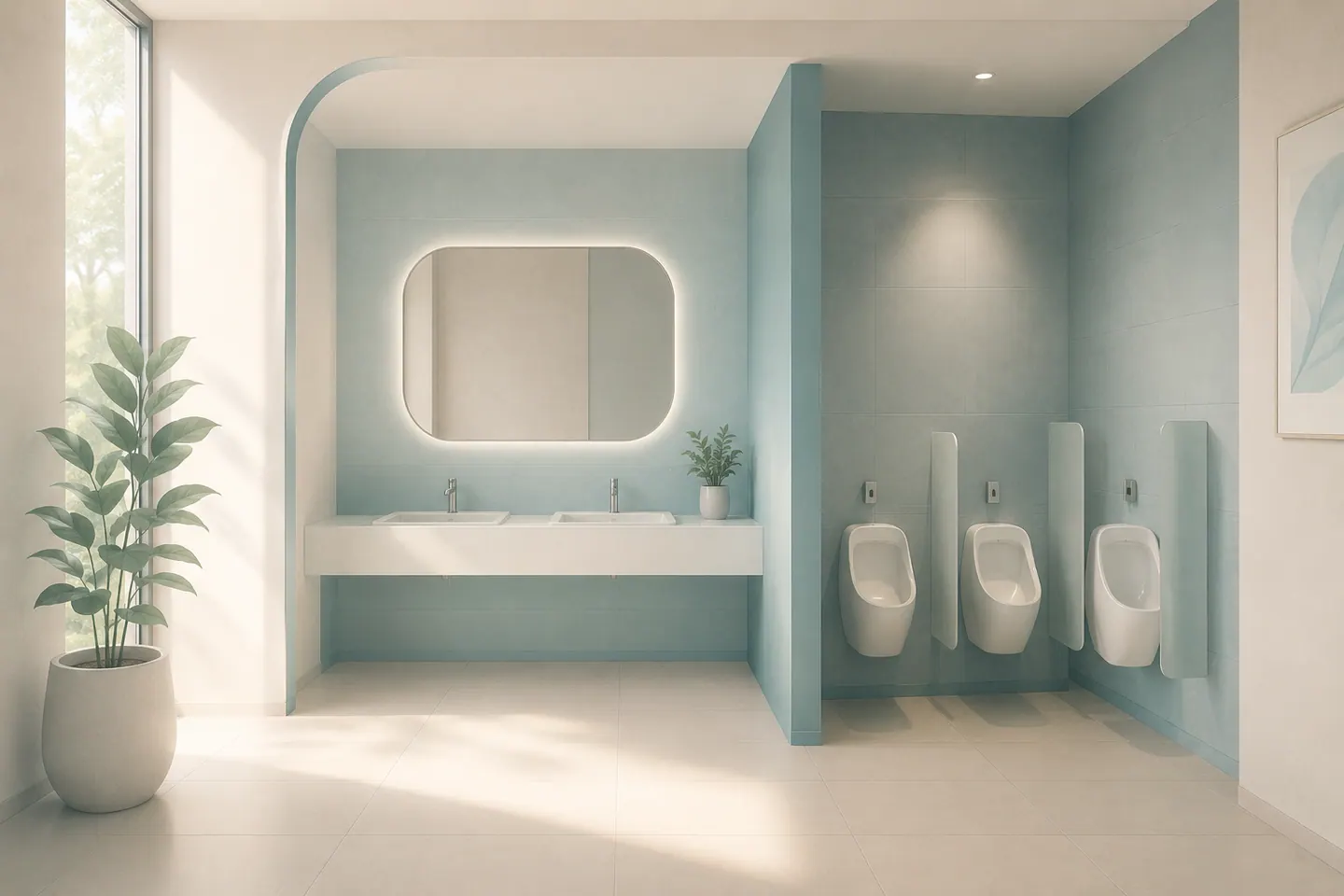
For a great many men, paruresis has a very specific home: the urinal. They might manage a private stall reasonably well, but step up to an open urinal with another man beside them, and everything locks. If that’s you, understand this first — urinal difficulty is one of the single most common expressions of paruresis, shared by enormous numbers of men who never breathe a word about it. The man washing his hands beside you may be fighting the exact same battle.
Why the urinal is so hard
The urinal is, in many ways, the perfect storm for shy bladder. Compared to a stall, it removes almost every protective layer at once:
- Exposure. You are physically out in the open, not enclosed. The sense of being seen — even from behind — is immediate.
- Proximity. Other men stand right beside you, sometimes just inches away, sharing the same small space.
- The feeling of being timed. There’s an unspoken etiquette of efficiency, and with it the unbearable thought: I’m taking too long, they’ll notice.
- No escape or concealment. A stall offers a door, a barrier, a private pocket. A urinal offers none of that.
For a nervous system already primed to treat being-watched as danger, this combination switches on fight-or-flight almost instantly — and the muscle clamps shut. It is not weakness; it is your alarm system doing exactly what it has learned to do, in the place most engineered to set it off.
The coping habits men build
Around urinal paruresis, men quietly construct a whole architecture of workarounds, usually without ever naming why:
- Always heading straight for a stall, even just to urinate.
- Using the end urinal, or waiting for a gap so no one is adjacent.
- Pretending to wash hands or check a phone until the room clears.
- “Holding it” through events, matches, flights, and nights out.
- Avoiding certain venues — stadiums, festivals, bars — known for busy, trough-style facilities.
These tricks get a man through the day, but each one quietly reinforces the underlying message that the urinal is too dangerous to face. The coping keeps the fear alive.
The good news: it responds well to practice
Because urinal paruresis is so situational and so clearly defined, it is often very workable with graduated exposure. The urinal gives you natural “dials” to build a ladder with — and that makes a structured climb straightforward:
- Start with the easiest case: an empty, quiet bathroom, end urinal, no one around.
- Progress to someone present but distant — at the sinks, or several urinals away.
- Move toward someone using a stall nearby, then a urinal a couple of spaces over.
- Step gradually toward busier rooms and closer proximity, only advancing when each stage feels routine.
Paired with slow breathing to keep the alarm from spiking and a conscious release of the pelvic floor, this steadily teaches your nervous system that the urinal is, in fact, safe. Rung by rung, the place that once guaranteed a freeze becomes ordinary.
Letting go of the stopwatch
One mental shift matters enormously for men at urinals: abandon the imaginary stopwatch. The belief that you must perform within some socially acceptable window is pure pressure, and pressure is what locks the muscle. The truth is that almost no one is actually monitoring you — everyone else is absorbed in their own business — and even if you take your time, it genuinely does not matter. Giving yourself permission to stand there unhurried, with no deadline and no obligation to succeed, removes the exact tension that was causing the block.
A bathroom is just a bathroom
The goal isn’t to white-knuckle your way through urinals forever. It’s to reach the point where the urinal stops carrying any charge at all — where you walk up, do your business, and walk away without a flicker of thought. That outcome is realistic and common. Urinal paruresis is one of the most recognised, most beatable forms of shy bladder, and the route there is gentle, private, and entirely doable.